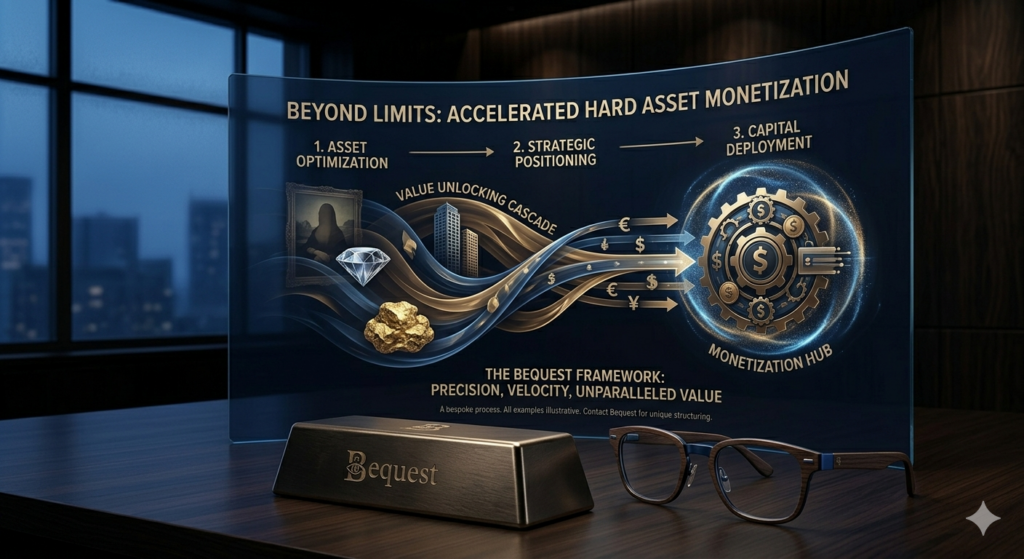
A Strategic Approach to Monetization
At Bequest, we understand that monetizing hard assets – such as works of art, precious stones, real estate, or raw materials – is a process that requires a specific mindset. It is crucial to understand that assets themselves do not automatically trigger credit lines. The mechanism that activates financing is a professional asset block, confirmed by the Investor’s Bank, with the Monetizing Bank.
Important Information: The following financial parameters and procedures are for illustrative purposes only. Each monetization project is unique, and the terms are individually tailored to the specifics of the asset, the current market situation, and the Service Provider’s requirements. This is not a standard service.
What the Process Looks Like (Step-by-Step)
1. Initial Review and Consultation
The process begins with documentation analysis and consultation with our experts. At this stage:
The investor pays an initiation fee (e.g., around €10,000), which covers the initial document review and selection of the appropriate Service Provider. Video conferences are held with lawyers from both parties to verify the client’s identity and the status of the assets.
2. Securitization and “Insurance Wrap”
Monetizing banks often require additional security because they may have difficulty independently valuing specific assets (e.g., paintings or mines). In such situations:
An insurance policy/underwriting agreement, known as an “insurance wrap,” is used. This allows the bank to assume full banking responsibility for the securitization of assets towards monetization.
3. Finalization and Banking Operations
After approval of the procedure, the deeds of agreement (DOA) are signed, detailing the fees, commissions, and closing procedures.
The market standard for monetizing large assets is a brokerage commission (e.g., 5% of the value) and success fees after the financing is completed.
All external costs (banking, legal, insurance) are the responsibility of the Asset Owner. Required Documentation (Checklist)
To be successful, all documents must be professionally synchronized and up-to-date (typically no older than 5 months). Key elements include:
Proof of Ownership: Copies of certificates and deeds.
Valuations and Reports: Certificates of Analysis (e.g., IGAS/ISE for metals), third-party valuation reports.
Depository Documentation: Safekeeping Receipts (SKR) – it is important to submit documents to the bank no older than 3 months.
Legal Documents: Letter of Intent (LOI), Customer Information Sheet (CIS/KYC), and Attestation Letter from a lawyer confirming the authenticity of the transaction.
Security and Compliance (AML)
In accordance with international regulations and the Anti-Money Laundering Act (AML):
Every Service Provider is required to fully verify the origin of funds and assets. Bequest, acting as a competence hub, coordinates cooperation with private banks and financial institutions, protecting investors from unnecessary costs and procedural errors.
Legal Notice:
The content contained in this section is for educational purposes. Bequest Europe is not a securities broker within the meaning of US/UK regulations and acts as a strategic consultant. All actions are taken after conducting full due diligence.